
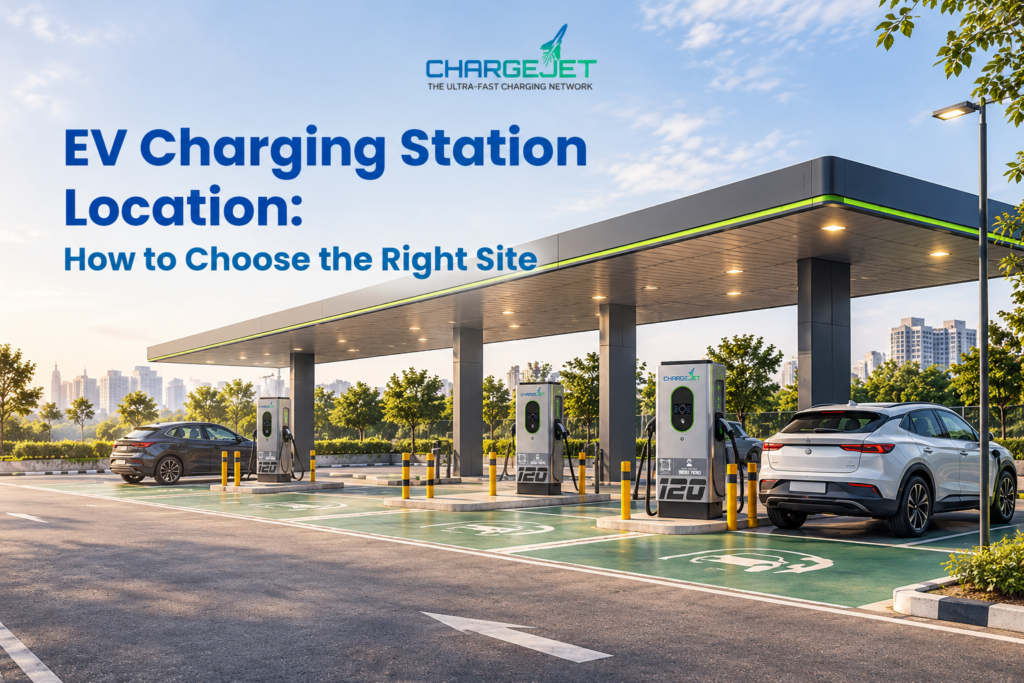
Choosing the right location is one of the most important decisions when establishing an electric vehicle (EV) charging station. The charger, technology and software may determine how a station operates, but its location influences customer accessibility, charging demand, infrastructure costs and long-term business potential.
A site near a busy highway may appear attractive, but does it have enough parking space? Can vehicles enter and exit easily? Is the electricity supply sufficient for the proposed charger capacity? Are there enough EV users travelling through that area?
These are the questions investors and property owners should consider before setting up an EV charging station.
With electric mobility expanding across India, the demand for charging infrastructure is creating opportunities for businesses, landowners, investors and commercial property operators. Rajasthan also offers several locations worth evaluating, including Jaipur, Udaipur, Jodhpur, Kota, Ajmer and other growing commercial and tourism destinations.
In this guide, we explain how to choose the best EV charging station location, the important factors to evaluate, suitable property types and the opportunities available for an EV charging business in Rajasthan.
What Is an EV Charging Station Location?
An EV charging station location is a physical site where electric vehicle charging equipment and the required supporting infrastructure are installed to provide charging services.
Depending on the business model, a charging station can be established at a public parking facility, highway stop, hotel, shopping complex, office building, fuel station, fleet depot or commercial property.
However, not every available property is suitable for charging infrastructure.
A commercially viable EV charging station location should combine five essential elements:
- Sufficient potential EV charging demand.
- Suitable electrical infrastructure and power availability.
- Convenient vehicle access and parking.
- Appropriate land or property arrangements.
- A sustainable operating and revenue model.
The objective is not simply to find an empty piece of land. It is to identify a location where charging infrastructure can operate efficiently and serve a clearly defined customer segment.
Why Is Location Important for an EV Charging Business?
An EV charging station is a location-dependent business. Its performance is influenced by the number of potential customers, how easily they can reach the facility and whether the site can support the required charging infrastructure.
Here are five reasons why location plays such an important role.
1. Charging Demand and Station Utilisation
A charging station needs customers who regularly require charging services.
Locations near residential communities, business districts, commercial establishments, transport hubs and fleet operating areas may offer opportunities to attract regular users.
However, high population or vehicle traffic alone does not guarantee charging demand. Investors should also examine EV movement, vehicle categories, nearby charging facilities and customer charging behaviour.
2. Accessibility for EV Users
A charging station should be easy to locate and access.
Complicated entry routes, restricted access, difficult U-turns or limited parking can discourage customers, even when the charger is installed in a busy area.
Clear signage, convenient entry and exit points, and reliable navigation information improve the overall charging experience.
3. Electricity Infrastructure
EV chargers require an appropriate electrical connection and supporting infrastructure.
The available electricity load, transformer capacity, distance from the power supply network and cost of electrical upgrades can influence project feasibility.
A property with good road visibility but inadequate power infrastructure may require substantial additional investment.
4. Operating Costs
Land rent, electricity infrastructure, civil work, maintenance and other operating expenses affect the financial performance of a charging station.
A location with expensive land may not be the best option if charging demand is insufficient to support the additional cost.
5. Long-Term Business Potential
Charging infrastructure should be planned with future requirements in mind.
A suitable site should ideally allow additional charging bays, electrical upgrades and infrastructure expansion when demand increases.
Choosing a location with long-term operational flexibility can reduce the need for major changes later.
10 Important Factors to Consider When Choosing an EV Charging Station Location
Before finalising a property, investors should evaluate the following factors together rather than relying on just one attractive feature.
1. Identify the Target Customer Segment
Start by understanding who will use the charging station.
Different customer segments have different charging requirements.
| Customer Segment | Potential Location |
| Private EV owners | Shopping centres, residential areas and public parking |
| Highway travellers | Highways, restaurants and fuel stations |
| Hotel guests | Hotels, resorts and hospitality properties |
| Corporate employees | Office complexes and business parks |
| Electric taxi operators | Taxi stands and transport hubs |
| Logistics and delivery fleets | Warehouses, industrial areas and fleet depots |
| Commercial vehicle operators | Transport corridors and dedicated fleet facilities |
For example, a charging station near a hotel may attract guests who park for several hours or overnight. A highway charging station may serve travellers who need a quicker charging stop.
The charger configuration and site layout should be planned according to the intended users.
2. Evaluate EV Traffic and Local Charging Demand
One of the most important steps in selecting an EV charging station location is assessing potential demand.
Before choosing a property, investigate:
- Number and type of EVs operating in the area.
- Traffic movement during different times of the day.
- Presence of electric taxi and delivery fleets.
- Nearby residential and commercial developments.
- Existing EV charging stations.
- Potential demand from businesses and fleet operators.
Do not evaluate demand only through general road traffic. A road may carry thousands of vehicles, but the number of EVs using that route and their charging requirements are more relevant to the business.
Where possible, conduct an on-ground traffic survey and speak with nearby businesses or fleet operators.
3. Check Electricity Availability and Grid Capacity
Electricity infrastructure is a critical consideration when evaluating an EV charging station site.
The power supply must support the proposed charging equipment and its expected operating requirements.
Important checks include:
- Available sanctioned electrical load.
- Distance from the nearest distribution transformer.
- Capacity of the local distribution network.
- Requirement for a new electricity connection.
- Transformer or electrical infrastructure upgrades.
- Cabling, metering and installation requirements.
- Applicable electricity tariff and connection costs.
The proposed charger capacity should be discussed with the relevant electricity distribution company (DISCOM) and qualified electrical professionals.
The Ministry of Power’s 2024 EV charging infrastructure guidelines provide the regulatory framework for charging connections and infrastructure. Investors should review the latest applicable requirements before proceeding.
4. Ensure Convenient Road Access
A charging station should be accessible without creating unnecessary inconvenience for drivers.
Evaluate the following:
- Is the site directly accessible from the main road?
- Can vehicles enter and exit safely?
- Is there sufficient space for turning and manoeuvring?
- Is the location easy to identify through navigation?
- Are there road restrictions or access limitations?
- Can customers access the station during its intended operating hours?
For highway charging stations, access from the correct direction of travel is especially important.
A location that requires a long detour or difficult U-turn may reduce its attractiveness to travellers.
5. Check Parking Space and Site Layout
Adequate parking is essential for the safe and convenient operation of an EV charging station.
The property should provide sufficient space for vehicles to park near the charging equipment without obstructing other vehicles or pedestrians.
Consider:
- Number of charging bays required.
- Vehicle dimensions and turning radius.
- Charger placement and cable reach.
- Vehicle movement and circulation.
- Entry and exit arrangements.
- Pedestrian safety.
- Space for future charging points.
The layout should be designed according to the proposed charger type, number of charging points and vehicle categories.
6. Analyse Nearby Charging Station Competition
Before investing in a location, understand the existing EV charging network around it.
Check nearby stations and compare:
- Distance from the proposed site.
- Charger type and power capacity.
- Connector compatibility.
- Availability and operating hours.
- Customer accessibility.
- Nearby fleet or commercial demand.
- Pricing, where publicly available.
The presence of another charging station does not automatically make a location unsuitable.
In some areas, multiple stations may be required to serve growing EV demand. The important question is whether the proposed site offers a useful location, suitable infrastructure or a customer segment that is not adequately served by existing facilities.
7. Consider Nearby Commercial Establishments
Locations near businesses and customer destinations can create additional value for an EV charging station.
Potential nearby establishments include:
- Restaurants and cafes.
- Hotels and resorts.
- Shopping malls.
- Petrol pumps.
- Office complexes.
- Hospitals.
- Tourist attractions.
- Retail and convenience stores.
These establishments may provide amenities that make charging stops more convenient.
For example, highway travellers may prefer a charging location where they can access food, refreshments and washroom facilities while their vehicles charge.
8. Evaluate Land Cost and Property Ownership
The cost and availability of land can significantly influence the financial feasibility of an EV charging project.
Before finalising a property, assess:
- Purchase, lease or rental cost.
- Ownership documents and land-use permissions.
- Duration of the lease agreement.
- Access rights and operating hours.
- Electricity connection arrangements.
- Responsibility for civil and electrical work.
- Possibility of future expansion.
For leased properties, the agreement should provide sufficient tenure to support the investment and define what happens to the charging equipment when the contract ends.
Landowners can also explore partnership or revenue-sharing arrangements with EV charging operators, depending on the site’s suitability and commercial terms.
9. Check Safety, Lighting and Security
Safety should be included in the site evaluation and infrastructure design from the beginning.
Important considerations include:
- Proper electrical protection and earthing.
- Safe cable routing.
- Adequate lighting.
- Clear parking markings and signage.
- Fire and emergency access planning.
- CCTV or other security arrangements where appropriate.
- Protection against unauthorised access.
- Suitable drainage and weather protection.
Electrical design, installation and safety provisions should be reviewed by qualified professionals in accordance with applicable regulations and standards.
10. Plan for Future Expansion
EV charging infrastructure should be designed to accommodate changing demand.
A site that supports only the initial installation may create limitations when additional chargers are required.
Before finalising the location, check whether the property can accommodate:
- Additional charging bays.
- Higher electrical load.
- Additional transformers or distribution equipment, if required.
- Improved parking and circulation.
- Customer amenities.
- Solar integration or other energy solutions, where technically feasible.
Future expansion should be considered during the initial site assessment rather than after the property has been fully developed.
Best Locations for Setting Up an EV Charging Station
Different property types serve different charging requirements. The right choice depends on the intended customer segment, charging duration, infrastructure availability and business model.
| Location Type | Potential Customer Segment | Key Site Consideration |
| Highways | Long-distance travellers | Road access, traffic and amenities |
| Hotels and Resorts | Guests and tourists | Parking and overnight stays |
| Shopping Malls | Shoppers and visitors | Parking availability and footfall |
| Petrol Pumps | Private and commercial EV users | Access, safety and electrical capacity |
| Office Complexes | Employees and visitors | Parking duration and demand |
| Fleet Depots | Commercial vehicle operators | Fleet size and charging schedules |
| Restaurants | Travellers and local customers | Customer dwell time |
| Transport Hubs | Taxis and commercial vehicles | Vehicle movement and accessibility |
1. Highway Locations
Highways can be suitable for EV charging stations because they serve intercity and long-distance travellers.
A good highway charging location should offer:
- Easy access from the highway.
- Sufficient parking space.
- Reliable electricity infrastructure.
- Clear directional signage.
- Food, refreshments and washroom facilities.
- Safe access during operating hours.
Highway-facing restaurants, fuel stations, hospitality properties and commercial stops may be worth evaluating.
However, traffic volume, EV movement, charger requirements and the cost of electricity infrastructure should be assessed before selecting a site.
2. Hotels and Resorts
Hotels and resorts can offer destination charging facilities for guests travelling with electric vehicles.
Guests may park for several hours or overnight, making these properties suitable for charging arrangements that align with longer parking durations.
This can also help hospitality businesses improve their facilities and offer additional convenience to EV-owning customers.
3. Shopping Malls and Commercial Complexes
Shopping centres, business parks and commercial complexes attract visitors who may remain at a property for an extended period.
Charging facilities can be integrated into existing parking areas, subject to electrical capacity, parking layout and property permissions.
4. Petrol Pumps and Fuel Stations
Fuel stations often have established road access, vehicle movement and supporting facilities.
They may be considered for EV charging infrastructure where adequate space, electrical capacity and safety arrangements are available.
The proposed installation should be evaluated carefully to ensure that EV charging operations do not interfere with existing fuel station activities.
5. Fleet Depots and Logistics Locations
Fleet depots and logistics facilities can offer opportunities for dedicated charging infrastructure.
Their suitability depends on the number of electric vehicles, daily travel patterns, charging schedules, parking arrangements and available electrical load.
A charging station serving a known fleet requirement may have a more predictable usage pattern than a site relying entirely on occasional public customers.
How to Choose the Best EV Charging Station Location: A Step-by-Step Process
A structured site-selection process helps investors avoid expensive decisions based on assumptions.
Step 1: Define Your Business Objective
Decide whether the proposed station will serve public EV users, highway travellers, hotel guests, commercial fleets or a combination of customer segments.
This will help determine the type of location and charger configuration required.
Step 2: Shortlist Potential Properties
Identify multiple properties rather than selecting the first available site.
Consider highway-facing land, commercial parking, hotels, fuel stations, fleet depots and other suitable properties.
Step 3: Conduct a Demand Assessment
Evaluate local EV movement, traffic patterns, nearby businesses, existing charging stations and potential fleet requirements.
Where possible, collect on-ground information rather than relying only on general market estimates.
Step 4: Perform an Electrical Feasibility Assessment
Check power availability, sanctioned load, transformer capacity, connection requirements and the cost of any electrical upgrades.
This assessment should be completed with the relevant DISCOM and qualified technical professionals.
Step 5: Evaluate Site Accessibility and Layout
Review road access, parking, turning space, signage, safety and the proposed charger placement.
Make sure the site can accommodate the intended vehicles and charging equipment.
Step 6: Estimate Project Costs
Prepare a project estimate covering:
- Land purchase, rent or lease.
- Charging equipment.
- Electricity connection and infrastructure.
- Civil and installation work.
- Software and network integration.
- Safety and security arrangements.
- Maintenance and operating expenses.
Step 7: Review Commercial Feasibility
Estimate potential charging demand and compare it with the expected investment and operating expenses.
Evaluate different utilisation scenarios rather than assuming that all chargers will operate at full capacity.
Step 8: Finalise the Site and Installation Plan
Once the technical, commercial and legal assessments are satisfactory, finalise the site arrangement and installation plan.
A professional EV charging infrastructure provider can help coordinate site evaluation, equipment selection, installation and operations.
EV Charging Station Location Opportunities in Rajasthan
Rajasthan is an important state to consider when evaluating EV charging infrastructure opportunities in India.
The state’s major cities, tourism destinations, commercial centres and highway corridors offer different potential use cases for public and destination charging.
The Rajasthan Electric Vehicle Policy 2022 identifies eight priority cities for EV-related initiatives: Jaipur, Jodhpur, Kota, Udaipur, Bikaner, Ajmer, Bharatpur and Alwar.
The state has also published public charging infrastructure initiatives through Rajasthan Renewable Energy Corporation Limited (RRECL), including projects associated with the PM E-Drive scheme.
For investors, this creates a reason to assess locations carefully rather than assuming that every city or highway property will have the same charging demand.
1. Jaipur
Jaipur is a major commercial, residential and tourism centre in Rajasthan.
Potential locations for EV charging infrastructure include:
- Hotels and hospitality properties.
- Shopping centres and commercial complexes.
- Business parks and office locations.
- Public parking facilities.
- Highway access points.
- Fleet operating locations.
For an EV charging station in Jaipur, investors should evaluate local EV demand, parking availability, nearby charging infrastructure and electricity capacity.
2. Udaipur
Udaipur is known for its tourism and hospitality sector.
Hotels, resorts, restaurants and tourist-oriented properties can explore destination charging facilities for guests.
Highway-facing properties around major travel routes may also be evaluated for en-route charging, subject to traffic patterns and site feasibility.
3. Jodhpur
Jodhpur is an important urban and tourism centre in western Rajasthan.
Potential opportunities include commercial parking locations, hospitality properties, business areas and routes connecting the city with other destinations.
The site assessment should consider both local vehicle demand and intercity movement.
4. Kota
Kota has a substantial educational, residential and commercial ecosystem.
Potential charging locations include shopping areas, residential developments, commercial parking facilities and locations serving taxis or other commercial vehicles.
Investors should assess parking patterns and EV demand before selecting a specific property.
5. Ajmer
Ajmer’s religious tourism, commercial activity and regional road connectivity make it a city worth evaluating for charging infrastructure.
Hotels, visitor parking facilities, commercial establishments and highway-linked locations may be considered.
6. Alwar and Bharatpur
Alwar and Bharatpur can be evaluated for urban charging, commercial property and intercity travel requirements.
Locations near business areas, hotels, parking facilities and major connecting roads may be suitable depending on local EV demand and electricity infrastructure.
7. Bikaner and Other Emerging Locations
Bikaner and other Rajasthan locations can also be assessed for charging opportunities.
Potential sites may include commercial properties, hospitality locations, fuel stations and highway stops.
The best location should always be selected using site-specific demand and electrical feasibility rather than city-level assumptions.
Rajasthan EV Charging Policy and Infrastructure Considerations
Investors planning an EV charging station in Rajasthan should review the applicable state and central government frameworks.
The Rajasthan Electric Vehicle Policy 2022 includes provisions relating to public charging infrastructure, land and electricity connections, and certain incentives for eligible charging infrastructure projects.
The Ministry of Power’s Guidelines for Installation and Operation of Electric Vehicle Charging Infrastructure 2024 provide the broader national framework for public, semi-public and private charging infrastructure.
Before investing, verify:
- Applicable land-use and local authority requirements.
- Electricity connection and load requirements.
- Current DISCOM procedures.
- Electrical safety and installation standards.
- Applicable state and central policy provisions.
- Eligibility and availability of any incentives.
Policy provisions and incentive conditions can change. Investors should confirm the latest notifications with the relevant government department or authority before including any subsidy or reimbursement in their project calculations.
Common Mistakes to Avoid When Selecting an EV Charging Station Location
Even a well-funded charging project can face operational challenges if the location is not evaluated properly.
Here are some common mistakes to avoid.
1. Selecting a site only because it is on a busy road
High traffic does not automatically translate into charging demand. Evaluate EV movement, road access and the ability of vehicles to stop safely.
2. Ignoring electricity infrastructure
A site may look commercially attractive but require expensive electrical upgrades. Check power availability before finalising the property.
3. Not checking nearby charging stations
Existing stations can influence customer demand. Compare their location, charger types, availability and customer accessibility.
4. Choosing inadequate parking space
Insufficient parking or difficult vehicle movement can affect customer convenience and station operations.
5. Overlooking property agreements
Unclear ownership, lease duration or access rights can create long-term operational problems.
6. Installing chargers without understanding the target customer
The charger type and power capacity should match the needs of the intended customer segment.
7. Ignoring future expansion
A site with no room for additional charging bays or electrical upgrades may limit future growth.
How ChargeJet Helps Businesses Explore EV Charging Locations
Selecting a suitable location is the starting point of a successful EV charging infrastructure project. Investors and property owners also need to understand the technical requirements, charging equipment, network integration and operational arrangements.
ChargeJet works with investors, landowners, businesses and fleet operators interested in developing EV charging infrastructure.
Its charging solutions cover different site requirements:
- En-Route Charging Stations: Highway charging infrastructure for intercity and long-distance travel.
- Staycation Chargers: Charging facilities for hotels, resorts and hospitality businesses.
- Charging Lounge: Charging locations designed to combine vehicle charging with customer convenience.
- Charging Hub: Scalable charging infrastructure for locations with multiple charging requirements.
ChargeJet’s partnership approach includes infrastructure and operational support, with project requirements assessed according to the proposed site and business arrangement.
If you own commercial land, operate a hotel, manage a business property or are exploring an EV charging business in Rajasthan, evaluating the site’s suitability is a practical first step.
You can learn more about ChargeJet’s charging solutions and partnership opportunities:
Final Checklist Before Finalising an EV Charging Station Location
Use this checklist to evaluate a potential property before moving ahead.
- Target customer segment identified.
- Local EV demand and traffic assessed.
- Nearby charging stations were evaluated.
- Electricity availability and grid capacity checked.
- Road access and vehicle movement reviewed.
- Parking space and charger layout assessed.
- Land ownership or lease arrangements verified.
- Safety and security requirements considered.
- Installation and operating costs estimated.
- Commercial feasibility reviewed.
- Future expansion potential assessed.
- Applicable permissions and regulations verified.
A location that meets these requirements is a stronger candidate for detailed technical and commercial evaluation.
Frequently Asked Questions About EV Charging Station Locations
1. What is the best location for an EV charging station?
The best location is one that combines sufficient EV demand, accessible road connections, suitable parking, reliable electricity infrastructure and commercially viable operating costs. Highways, hotels, shopping centres, fuel stations and fleet depots can all be suitable depending on the target customer segment.
2. How do I choose an EV charging station location?
Start by identifying your target customers and assessing local EV demand. Then evaluate road access, electricity capacity, parking, competition, land costs, safety and future expansion possibilities. Complete a technical and commercial feasibility assessment before finalising the site.
3. Which locations are suitable for an EV charging business in Rajasthan?
Jaipur, Udaipur, Jodhpur, Kota, Ajmer, Alwar, Bharatpur and Bikaner are among the cities identified as priority cities in Rajasthan’s EV Policy 2022. Suitable properties may include hotels, commercial complexes, highway stops, fuel stations and fleet facilities. Individual sites still require demand and infrastructure assessment.
4. Is a highway location suitable for an EV charging station?
A highway location can be suitable when it has convenient road access, sufficient EV traffic, parking, electrical capacity and supporting amenities. Investors should also check access from both directions of travel and the availability of safe entry and exit points.
5. How much land is required for an EV charging station?
There is no single land requirement for every EV charging station. The required area depends on the number of chargers, charger type, vehicle dimensions, parking bays, electrical equipment, circulation space and future expansion plans.
6. Does an EV charging station require a high-capacity electricity connection?
The electricity connection depends on the total charger load and proposed charging configuration. Higher-power installations may require additional electrical infrastructure. The site should be assessed with the relevant DISCOM and qualified electrical professionals before installation.
7. Can landowners partner with EV charging companies?
Yes. Landowners with suitable commercial, roadside or parking properties can explore partnerships with EV charging companies. Depending on the arrangement, the property owner may provide the land while the charging operator supports infrastructure setup and operations. Commercial terms should be agreed upon in writing.
8. Why should I evaluate a location before investing in an EV charging station?
Location evaluation helps identify potential demand, electrical infrastructure requirements, installation costs, competition and operating challenges. It can help investors avoid unsuitable properties and make better-informed investment decisions.
Conclusion
Choosing the right EV charging station location is the foundation of a successful EV charging business. From highways and commercial properties to hotels, resorts and fleet locations, every site presents different opportunities. The key is to identify the right location, evaluate its potential and build the charging infrastructure around actual customer requirements.
At ChargeJet, we help investors, landowners and businesses take the next step towards establishing EV charging infrastructure. With solutions covering En-Route Charging, Staycation Chargers, Charging Lounges and Charging Hubs, we work towards making EV charging opportunities more accessible across different business environments.
Whether you are planning to invest in an EV charging station in Rajasthan, own suitable commercial property or explore an EV charging partnership, ChargeJet can help you explore the possibilities and take your project forward.
Turn your property or investment plan into an EV charging opportunity with ChargeJet.