
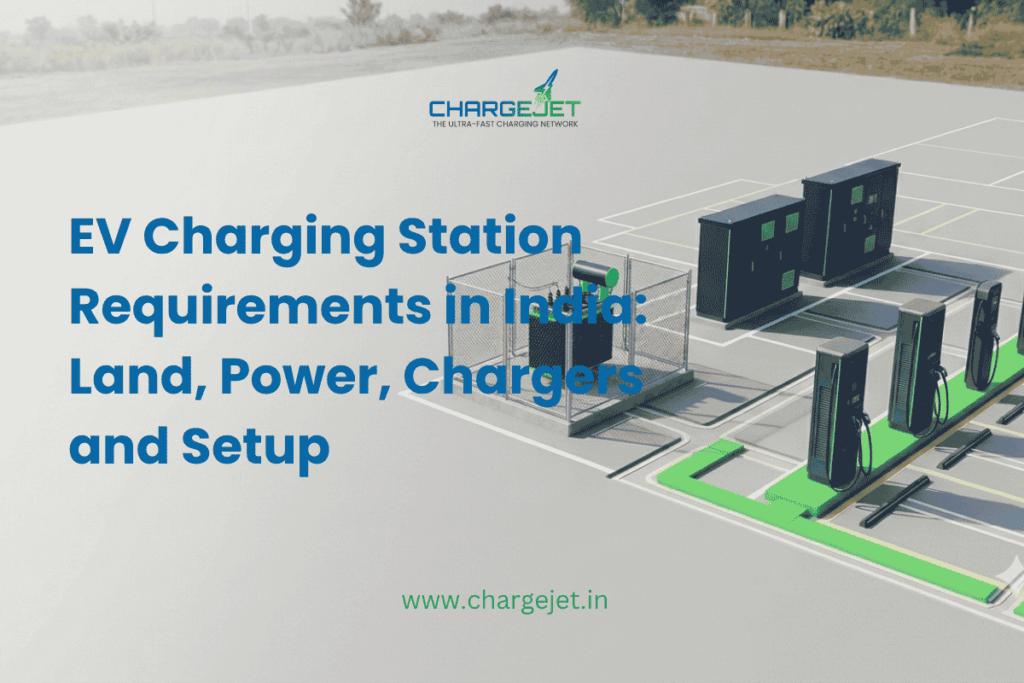
India’s electric mobility ecosystem is creating new opportunities for investors, property owners, fuel station operators, and entrepreneurs. As electric vehicles become more common, the need for accessible, reliable, and strategically located charging facilities is also growing.
However, setting up a commercial EV charging station involves more than purchasing a charger. Investors must evaluate land availability, electricity supply, charging equipment, site accessibility, safety requirements, and long-term operating costs.
EV charging infrastructure in India refers to the complete system required to charge electric vehicles, including charging equipment, electrical connections, power distribution systems, software, safety installations, and the supporting site infrastructure.
Whether you want to establish a highway charging hub, install chargers at a commercial property, or partner with an EV charging network, understanding these requirements can help you plan your investment more effectively.
This guide explains the essential EV charging station requirements in India, including land, power, equipment, installation, regulations, and business models.
1. What Is EV Charging Infrastructure?
EV charging infrastructure includes the equipment, electrical systems, software, and physical facilities needed to deliver electricity safely to electric vehicles.
A commercial charging station may include:
- EV chargers: AC or DC charging equipment selected according to vehicle requirements and expected demand.
- Electrical infrastructure: Electricity connections, distribution boards, cables, metering, protection systems, and transformers where required.
- Charging connectors: Compatible connectors for the vehicles the station intends to serve.
- Charging management software: Systems for monitoring charger status, managing payments, tracking energy consumption, and supporting customers.
- Civil infrastructure: Parking bays, foundations, cable trenches, road access, signage, and lighting.
- Safety systems: Earthing, electrical protection, emergency isolation, and other applicable safety provisions.
The scale of these components depends on the type of charging station and its intended use.
For example, a charging point at an office may need a relatively simple installation because vehicles remain parked for several hours. A highway charging hub may require higher power capacity, multiple charging points, greater parking space, and more substantial electrical infrastructure.
2. EV Charging Station Land Requirements in India
Land is one of the first factors to evaluate when planning an EV charging station. The required area depends on the number of chargers, vehicle type, parking layout, access roads, electrical equipment, and any additional facilities.
There is no single land-area requirement that applies to every commercial charging station. The layout should be designed around the project’s capacity and operating model.
How much land is required for an EV charging station?
The following are preliminary planning examples, not statutory minimums or approved design specifications.
| Charging station type | Initial site-planning consideration |
| Small charging installation | Existing parking space with room for chargers and safe vehicle access |
| Commercial charging station | Multiple parking bays, electrical equipment space, and suitable vehicle circulation |
| Highway fast-charging hub | Multiple charging bays, convenient entry and exit, and space for future expansion |
| Fleet charging depot | Dedicated vehicle parking, charging schedules, and electrical infrastructure designed for fleet demand |
The final land requirement should be established after preparing a site layout and confirming applicable local requirements.
Factors that determine land requirements
1. Number of charging points
Each charger requires appropriate vehicle access and a safe parking arrangement. Additional space may also be needed for electrical panels, cable routing, and maintenance access.
2. Vehicle type
A station serving electric two-wheelers will have different space requirements from a facility designed for electric cars, buses, or commercial trucks.
3. Charger placement
Chargers should be positioned so that vehicles can connect and disconnect safely without blocking access routes or other charging bays.
4. Traffic flow and accessibility
Entry and exit arrangements are particularly important at highway locations. Vehicles should be able to enter, charge, and leave without creating unnecessary congestion.
5. Supporting amenities
Restrooms, seating, refreshments, retail facilities, and other amenities may require additional land, depending on the business model.
6. Future expansion
If charging demand increases, additional chargers may be needed. Planning for future electrical capacity and expansion space can reduce later redevelopment costs.
Can you set up an EV charging station on existing commercial land?
Yes. Suitable existing properties may be considered for EV charging installations, subject to electrical feasibility, site access, safety, and applicable local requirements.
Potential locations include:
- Petrol pumps and highway facilities.
- Hotels, restaurants, and roadside businesses.
- Shopping centres and commercial complexes.
- Office buildings and business parks.
- Parking facilities and transport hubs.
- Fleet depots and logistics properties.
For landowners, partnering with an EV charging network can be an alternative to independently purchasing and managing all the charging equipment.
3. EV Charging Station Power Requirements in India
Power availability is a critical part of EV charging infrastructure planning. The electricity supply must support the chargers’ power ratings, expected simultaneous usage, and any other electrical loads at the site.
The required capacity depends on the number and type of chargers installed.
How much power is required for an EV charging station?
The following examples illustrate charger demand before accounting for electrical losses, auxiliary loads, and design margins.
| Charger Configuration | Combined Rated Charger Power |
| 2 × 22 kW AC chargers | 44 kW |
| 2 × 60 kW DC chargers | 120 kW |
| 2 × 80 kW DC chargers | 160 kW |
| 4 × 60 kW DC chargers | 240 kW |
| 2 × 120 kW DC chargers | 240 kW |
| 4 × 90 kW DC chargers | 360 kW |
| 2 × 180 kW DC chargers | 360 kW |
These figures represent the sum of the chargers’ rated power, not a final sanctioned-load recommendation. A qualified electrical professional must assess the site’s complete load, demand management arrangements, supply characteristics, and applicable utility requirements.
For example, a station with four 60 kW DC chargers may need to support up to 240 kW of combined charger demand if all four operate at their rated output simultaneously. The actual grid connection and equipment design may need additional capacity depending on the site.
What determines the power requirement?
Charger capacity: A 60 kW DC charger requires a different electrical supply arrangement from a 7.4 kW AC charger.
Number of chargers: More charging points increase the potential simultaneous load.
Simultaneous charging: If multiple vehicles charge at the same time, the station must manage their combined power demand or use a suitable load-management system.
Existing electrical infrastructure: A property with sufficient electrical capacity may require fewer upgrades than a site with limited supply.
Future expansion: Investors should assess whether the electrical system can accommodate additional chargers as demand grows.
Do EV charging stations require a transformer?
Not every charging station requires a new transformer. The requirement depends on the existing supply infrastructure, total load, voltage level, utility conditions, and project design.
Smaller installations may be feasible with an appropriate existing connection. Higher-capacity installations may require a transformer, additional distribution equipment, or other upgrades.
Before purchasing chargers, consult the relevant electricity distribution company (DISCOM) and a qualified electrical professional to confirm:
- Available supply capacity.
- Connection type and sanctioned load.
- Transformer or distribution upgrade requirements.
- Metering and protection arrangements.
- Applicable electricity tariff and demand charges.
- Expected connection costs and timelines.
India’s Ministry of Power issued consolidated EV charging infrastructure guidelines in September 2024. The framework includes provisions intended to facilitate electricity connections, with low-tension connections available as an option for eligible charging loads, subject to applicable conditions. Review the official Ministry of Power guidelines for the relevant requirements.
4. Choosing the Right EV Charger for Your Site
The charger type affects installation costs, power requirements, charging time, and the customers your station can serve.
AC charging stations
AC chargers are generally suitable for locations where vehicles remain parked for extended periods.
Typical applications include:
- Offices and business parks.
- Hotels and hospitality properties.
- Residential and commercial parking facilities.
- Destinations where customers spend several hours.
AC charging may offer a lower-cost entry point, although the final installation cost still depends on the electrical work and site conditions.
DC fast-charging stations
DC fast chargers supply direct current to the vehicle’s battery through compatible charging equipment and are commonly used where drivers need shorter charging stops.
Potential applications include:
- Highway charging stations.
- Busy commercial locations.
- Urban charging hubs.
- Fleet facilities with appropriate charging schedules.
- Transport and logistics locations.
DC charging typically involves greater equipment and electrical infrastructure requirements than a basic AC installation.
How should investors choose?
The appropriate charger depends on the location, target vehicle types, expected charging duration, available power, and business objectives.
A highway site may benefit from DC fast charging because travellers generally want to minimise their stops. An office property may find AC charging more suitable because employees park for longer periods.
The decision should be based on demand and site feasibility rather than charger capacity alone.
5. Essential Electrical and Technical Infrastructure
Installing charging equipment is only one part of an operational EV charging station. The supporting electrical and technical systems are equally important.
Electricity connection and distribution
The site requires a suitable connection, metering, distribution equipment, cables, and protection systems. The configuration must be designed to handle the expected electrical load safely.
Earthing and electrical protection
Electrical installations should include appropriate earthing, overcurrent protection, fault protection, isolation, and other safeguards required by applicable standards and equipment specifications.
The installation should be assessed and commissioned by qualified professionals.
Cable management and civil work
Cable routing should protect cables from physical damage and avoid creating trip hazards or obstructing vehicles. Depending on the layout, installation may involve cable trenches, foundations, protective enclosures, and parking modifications.
Charging software and connectivity
A commercial station may need a charging management platform to monitor charger availability, manage transactions, track energy usage, and support remote troubleshooting.
The required functionality depends on the business model and the operator’s technical requirements.
Safety, signage, and lighting
Clear signage, suitable lighting, emergency procedures, and safe vehicle circulation improve the usability of the station. Fire safety and other requirements should be assessed according to the site, equipment, building use, and applicable regulations.
6. EV Charging Station Setup: Step-by-Step Process
A structured setup process can help investors identify technical challenges before committing to major expenses.
Step 1: Identify a suitable location
Assess traffic, nearby EV charging facilities, target customers, road access, parking, and commercial demand.
For highway sites, consider the distance between existing charging facilities and the services available to drivers. For urban sites, evaluate parking duration, local EV adoption, and access during operating hours.
Step 2: Conduct a site feasibility assessment
Review the land layout, ownership or lease terms, electrical supply, parking arrangement, and installation constraints.
The assessment should identify the proposed number of chargers, power requirements, necessary civil work, and possible electrical upgrades.
Step 3: Select the charging technology
Choose AC or DC chargers based on the expected users and charging patterns. Confirm compatible connectors, power ratings, equipment certifications, and the ability to expand the installation if required.
Step 4: Obtain electrical and utility approvals
Coordinate with the relevant DISCOM and qualified electrical professionals to confirm the supply arrangement, sanctioned load, metering, connection process, and applicable technical requirements.
Step 5: Prepare the project budget
Include charger procurement, installation, electrical infrastructure, civil work, land or lease expenses, software, safety systems, and initial operating costs.
A detailed quotation should distinguish between equipment costs and site-specific installation expenses.
Step 6: Complete installation and commissioning
Install the electrical systems and chargers according to the approved design and applicable standards. Complete testing, safety checks, payment integration, and operational verification before opening the station.
Step 7: Plan station operations
Define charging prices, payment methods, maintenance schedules, customer support, monitoring, and procedures for handling equipment faults.
Operational reliability is important for customer experience and the long-term performance of the charging business.
7. Regulatory Requirements for EV Charging Infrastructure in India
EV charging station owners and operators must understand the applicable national guidelines and any requirements relevant to their specific location.
The Ministry of Power’s Guidelines for Installation and Operation of Electric Vehicle Charging Infrastructure, 2024 cover charging infrastructure in private parking spaces, semi-restricted locations, public places, and highways.
Setting up a public EV charging station is generally an unlicensed activity under the national framework. However, this does not remove the need to comply with applicable electricity, electrical safety, building, fire safety, land-use, and local authority requirements.
Before starting a project, review the following:
- Ministry of Power charging infrastructure guidelines.
- Applicable Central Electricity Authority safety regulations and technical requirements.
- DISCOM connection and sanctioned-load procedures.
- Local building, parking, and land-use requirements.
- Applicable fire and emergency safety provisions.
- Relevant equipment standards and testing requirements.
- Current state policies and any scheme-specific eligibility conditions.
Requirements can differ by site and project type. Investors should obtain advice from qualified professionals and the relevant authorities rather than relying on a generic checklist alone.
8. What Does EV Charging Infrastructure Cost?
The total investment depends on charger capacity, equipment specifications, electrical upgrades, land costs, civil work, and software.
The following figures are broad planning examples rather than verified market quotations.
| Cost component | What to include |
| Charging equipment | AC or DC chargers, connectors, and accessories |
| Electrical infrastructure | Connection, transformer if needed, distribution panels, cabling, and protection |
| Civil work | Foundations, parking bays, trenches, paving, and site modifications |
| Land and property | Purchase, lease, deposit, or revenue-sharing arrangements |
| Software and connectivity | Charging management, payments, remote monitoring, and internet |
| Safety and amenities | Signage, lighting, safety equipment, and any additional facilities |
| Operating budget | Electricity, rent, maintenance, staff, and customer support |
There is no single setup price suitable for every project. A small AC installation on an existing property can have a substantially different cost profile from a multi-charger highway hub.
For an accurate estimate, investors should request a site-specific feasibility assessment and an itemised project quotation.
9. EV Charging Business Models for Landowners and Investors
Investors do not always need to manage every part of the charging operation themselves. The available commercial arrangements depend on the charging network, site, investment capacity, and contract.
Own and operate
The investor funds the charging infrastructure and manages the station’s commercial operations.
This approach offers greater control over pricing and operations but also involves responsibility for capital expenditure, maintenance, electricity costs, and customer service.
Partner with a charging network
An investor can work with a charging network or charge point operator (CPO) to establish and manage a charging station.
Depending on the agreement, the partner may provide equipment, software, maintenance, or operational support. Responsibilities and revenue arrangements must be defined in the contract.
Provide land for a charging station
Landowners with suitable commercial properties may explore partnerships with charging operators.
Depending on the agreement, the arrangement may involve fixed rent, revenue sharing, or another commercial structure. Site suitability, electrical capacity, accessibility, and contract duration are important considerations.
Which model should you consider?
The appropriate model depends on the capital you want to invest, your willingness to manage operations, the suitability of your property, and the commercial terms available.
Compare the total investment, operating responsibilities, expected demand, and contract conditions before deciding.
10. Government Support for EV Charging Infrastructure
India has introduced policy measures to encourage electric mobility and expand charging infrastructure.
The Ministry of Power’s 2024 guidelines address the installation and operation of charging stations, electricity connections, and other aspects of infrastructure development.
The PM E-DRIVE scheme also includes funding for public EV charging infrastructure. However, the scheme’s funding framework is not an automatic subsidy for every private investor.
Under the published implementation framework, eligible government ministries, central public-sector enterprises, states, union territories, and their public-sector undertakings can submit proposals through designated nodal agencies. Charging operators may be engaged to implement eligible projects.
For scheme details, refer to the official PM E-DRIVE portal and its scheme guidelines.
Investors should verify current eligibility, funding availability, applicable deadlines, and implementation arrangements before including potential financial support in their project calculations.
11. Common Mistakes to Avoid During EV Charging Station Setup
Even a technically suitable site can become commercially challenging if important planning decisions are overlooked.
Choosing land without assessing demand: A convenient location does not automatically guarantee sufficient charging sessions.
Underestimating power requirements: Limited electrical capacity may lead to additional connection costs and project delays.
Selecting unsuitable chargers: Equipment should match the target vehicles, parking duration, and expected charging demand.
Ignoring operating expenses: Electricity, rent, software, repairs, and downtime all influence the station’s financial performance.
Overlooking expansion plans: Electrical infrastructure and site layouts should be assessed for potential future growth.
Assuming incentives are guaranteed: Scheme eligibility and funding must be verified before relying on financial support.
Entering unclear partnership agreements: Investment responsibilities, revenue sharing, maintenance, equipment ownership, and exit terms should be documented clearly.
A feasibility assessment that covers both technical and commercial considerations can help reduce these risks.
Frequently Asked Questions
1. What are the main EV charging station requirements in India?
The main requirements include suitable land or parking space, an adequate electricity connection, compatible chargers, electrical protection, safe installation, charging management systems where needed, and compliance with applicable national and local requirements.
2. How much land is required for an EV charging station in India?
The required land area depends on the number of chargers, vehicle types, parking layout, electrical equipment, access roads, and supporting facilities. There is no single area requirement that applies to all commercial charging stations.
3. What is the power requirement for an EV charging station?
Power requirements depend on the total charger capacity and expected simultaneous demand. For example, two 60 kW DC chargers have a combined rated power of 120 kW. The final electrical connection must be assessed based on the complete site load and applicable utility requirements.
4. Can an EV charging station operate without a new transformer?
Yes, if the existing electrical infrastructure can support the proposed load and meets the applicable requirements. A transformer or other electrical upgrades may be necessary for higher-capacity installations or sites with limited supply.
5. Which charger is suitable for a commercial EV charging station?
AC chargers are generally suitable for longer parking durations, while DC fast chargers are commonly used where quicker charging and higher vehicle turnover are priorities. The selection depends on customer demand, site power, vehicle compatibility, and budget.
6. Can I set up an EV charging station on my own land?
Potentially, yes. Your property must be suitable for the intended installation, with appropriate access, electrical feasibility, and compliance with applicable requirements. A site assessment can help determine whether installation is practical.
7. Is setting up an EV charging station a licensed business in India?
Under the Ministry of Power’s national framework, setting up a public EV charging station is generally an unlicensed activity. However, applicable electricity, safety, building, land-use, and other regulatory requirements still need to be followed.
8. Can landowners partner with EV charging companies?
Yes. Depending on the operator’s business model, eligible landowners may explore rental, revenue-sharing, or other partnership arrangements. The commercial terms, site requirements, and responsibilities vary between operators.
9. What factors affect the cost of EV charging infrastructure?
The primary factors include charger capacity, equipment prices, electrical connection and upgrades, land or rent, civil work, software, safety systems, and ongoing operating expenses.
10. Are government subsidies available for EV charging stations?
Support may be available through specific schemes and eligible implementation arrangements. Investors should verify the current guidelines and eligibility conditions rather than assume that every privately funded project qualifies for a subsidy.
Conclusion: Build Your EV Charging Infrastructure with a Clear Plan
Setting up EV charging infrastructure in India requires careful planning across land, electricity, charging technology, safety, and operations.
The right site must support the intended vehicle types, provide sufficient electrical capacity, and offer convenient access to customers. A well-designed charging station should also account for installation costs, operating expenses, and potential future expansion.
For investors and landowners, understanding these requirements is the first step towards evaluating an EV charging business opportunity.
Explore EV Charging Opportunities with ChargeJet
ChargeJet helps investors and partners explore EV charging infrastructure opportunities, including charging station planning, setup, and operational support.
If you are considering a new charging station or want to explore a partnership for a suitable property, connect with ChargeJet to discuss your site, power requirements, and business objectives.
Plan your EV charging infrastructure with a solution aligned with your location and investment goals.