
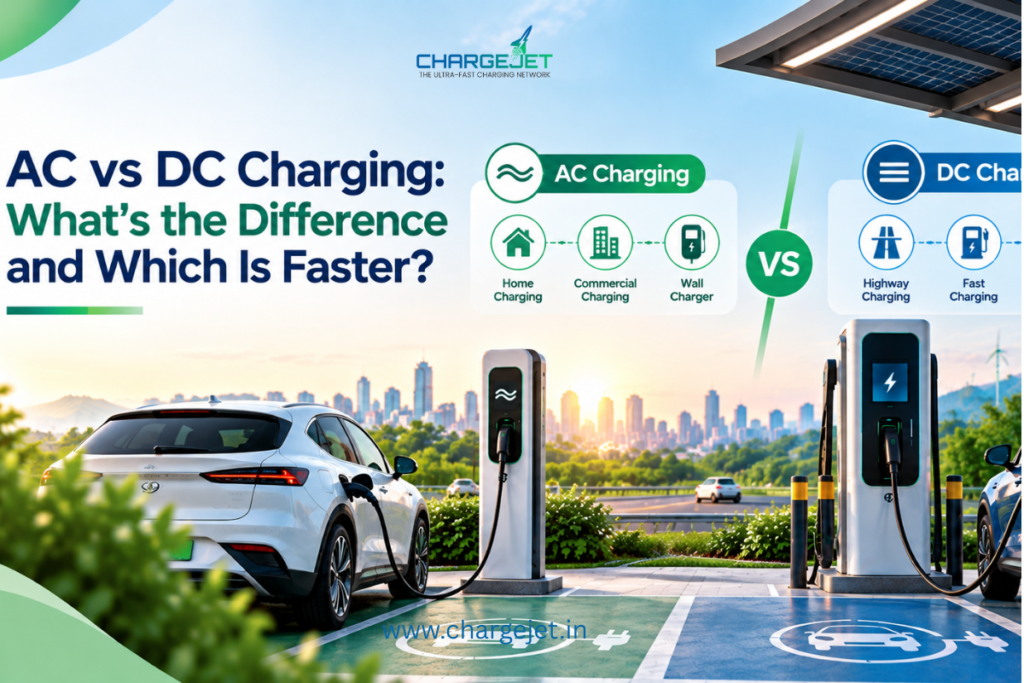
When choosing an EV charging station, one of the first questions people ask is simple: AC or DC charging, which is faster?
The short answer is DC charging is generally faster than AC charging because DC fast chargers can deliver direct current to the vehicle’s battery at much higher power levels.
But speed is only one part of the decision.
AC and DC charging serve different purposes. AC charging can be well suited for homes, workplaces, hotels and locations where an EV remains parked for several hours. DC fast charging is designed for situations where drivers need to recharge more quickly, such as highway travel, long-distance journeys, fleets and high-demand charging locations.
Understanding the difference between AC and DC EV charging helps businesses, EV owners and charging infrastructure planners choose the right charging solution for each location.
What Is AC EV Charging?
AC charging uses alternating current from the electrical grid.
The electricity reaches the EV and is then converted from AC to DC through the vehicle’s onboard charger before being stored in the battery.
This makes the vehicle’s onboard charging system an important part of the overall charging process.
AC charging is commonly used where the vehicle is expected to remain parked for a longer period.
Typical locations include:
- Homes
- Offices
- Hotels
- Resorts
- Residential communities
- Commercial properties
- Long-duration parking facilities
The main advantage of AC charging is that it can provide practical charging without requiring the very high power infrastructure associated with many DC fast-charging installations.
What Is DC Charging?
DC charging works differently.
A DC fast charger converts the electrical power before it reaches the vehicle, allowing direct current to be supplied to the vehicle’s battery system.
This enables much higher charging power in suitable applications.
That is why DC fast charging is commonly associated with:
- Highway EV charging stations
- Long-distance travel
- EV charging hubs
- Commercial fleets
- High-traffic locations
- Shorter parking durations
- High-power EV charging
The actual charging speed still depends on several factors, including the EV’s maximum charging capability, battery condition, state of charge, charger capacity and available electrical power.
AC vs DC EV Charging: What Is the Difference?
The simplest difference is where the AC-to-DC conversion takes place.
With AC charging, the vehicle’s onboard charger performs the conversion.
With DC charging, the charging equipment performs the conversion before supplying DC power to the vehicle’s battery system.
This difference allows DC charging equipment to support substantially higher charging power in appropriate applications.
| Feature | AC Charging | DC Charging |
| Power type supplied | AC | DC |
| Conversion | Mainly inside the vehicle | Mainly inside the charging equipment |
| Typical charging speed | Slower | Faster |
| Common use | Homes, offices, hotels, destinations | Highways, fleets, charging hubs |
| Typical parking duration | Longer | Shorter |
| Infrastructure requirement | Generally simpler | Generally more demanding |
| Best suited for | Destination charging | Fast and high-power charging |
Which Is Faster: AC or DC Charging?
DC charging is generally faster than AC charging.
The reason is that DC charging can bypass the vehicle’s onboard AC-to-DC conversion process and deliver higher power directly to the battery system.
However, the charger rating alone does not determine charging speed.
For example, connecting an EV capable of accepting only a limited DC charging power to a much higher-powered charger does not mean the vehicle will automatically charge at the maximum charger output.
The vehicle’s charging capability remains an important limiting factor.
This is why EV charging speed should always be considered as a combination of:
Charger power + vehicle charging capability + battery condition + state of charge + available electrical power
Why Is DC Fast Charging Faster?
DC fast charging is designed to deliver significantly more power than many conventional AC charging setups.
In an AC charging setup, the electricity passes through the vehicle’s onboard charger before reaching the battery.
In a DC charging setup, the conversion happens within the charging equipment, allowing the charging system to deliver DC power directly to the vehicle’s battery system.
This makes high-power DC charging particularly useful when charging time needs to be reduced.
For example, a driver travelling on a highway may not want to remain parked for several hours. A DC fast charging station can provide a much faster charging experience, subject to the vehicle’s capabilities and the station’s available power.
What Is High-Power EV Charging?
HighPower EV Charging refers to charging infrastructure designed to deliver higher levels of electrical power to compatible electric vehicles.
High-power charging becomes particularly useful in environments where vehicles have shorter dwell times or where multiple EVs need to be served efficiently.
Common applications include:
- Highway charging
- Intercity travel
- EV charging hubs
- Commercial fleets
- High-traffic locations
- Large destination charging facilities
The goal is not simply to install the highest-power charger available.
The charging infrastructure needs to match the site’s electrical capacity, expected EV traffic, vehicle compatibility and business requirements.
What Is Ultra-Fast EV Charging?
Ultrafast EV Charging is generally used to describe very high-power DC charging designed to significantly reduce charging time for compatible vehicles.
Ultra-fast charging is particularly relevant to the development of modern highway and high-demand EV charging networks.
For a vehicle capable of accepting high charging power, an ultra-fast charger can provide considerably more energy in a shorter period compared with conventional AC charging.
However, charging speed is not constant throughout an entire charging session.
EV batteries typically adjust their charging power as the battery state of charge increases. As a result, the maximum charger rating should not be interpreted as the constant charging speed from an empty battery to full.
How Long Does AC Charging Take?
There is no single charging time for AC charging.
Charging duration depends on:
- Battery capacity
- AC charger power
- Vehicle’s onboard charger
- Current battery state of charge
- Charging efficiency
- Vehicle charging settings
For example, an EV that remains parked overnight may have enough time to recharge using AC charging.
This makes AC particularly practical for locations where the vehicle is naturally stationary for several hours.
How Long Does DC Fast Charging Take?
DC charging can significantly reduce charging time compared with lower-power AC charging, but the actual duration varies from vehicle to vehicle.
Factors include:
- DC charger capacity
- Vehicle’s maximum DC charging rate
- Battery size
- Battery temperature
- Starting state of charge
- Charging curve
- Available power at the station
A vehicle that supports high-power DC charging can take advantage of a higher-capacity charger, while a vehicle with a lower maximum charging rate will draw less power.
This is why the charging station and the vehicle need to be considered together.
AC Charging vs DC Charging: Which One Should You Choose?
The answer depends on how and where the vehicle is being used.
Choose AC Charging When:
AC charging can make sense when the vehicle remains parked for longer periods.
For example:
- Overnight home charging
- Workplace charging
- Hotel charging
- Resort charging
- Long-duration parking
- Destination charging
Here, charging speed may be less important because the vehicle is already going to remain at the location.
Choose DC Fast Charging When:
DC fast charging becomes more relevant when reducing charging time is important.
Typical examples include:
- Highway travel
- Long-distance journeys
- Commercial fleets
- Taxi and ride-hailing fleets
- EV charging hubs
- High-traffic locations
- Shorter dwell-time destinations
The objective is to deliver more energy during a shorter stop.
AC vs DC Charging for Businesses
For businesses planning an EV charging solution, the choice between AC and DC should be based on the expected customer journey.
A hotel may benefit from AC charging because guests can leave their vehicles parked for several hours.
A highway charging station may require high-power DC charging because drivers typically want to continue their journey quickly.
A commercial fleet operation may need a combination of charging options depending on vehicle schedules and operating hours.
This means there is no universal answer to the question of which charging technology is better.
The better question is:
Which charging technology is appropriate for this location, vehicle type and charging requirement?
AC vs DC Charging for Highway EV Charging
Highway charging is one of the strongest applications for DC fast charging.
A highway EV charging station needs to support drivers who are travelling longer distances and typically have limited time available for charging.
This makes factors such as these particularly important:
- High-power DC chargers
- Strategic station locations
- Multiple charging bays
- Sufficient electrical capacity
- Easy vehicle access
- Reliable network connectivity
- Payment systems
- Monitoring and operational support
For high-traffic highway locations, multiple DC chargers can also help serve several vehicles at the same time.
Can a Charging Station Have Both AC and DC Chargers?
A charging station can be designed with both AC and DC chargers when the location has different user requirements.
For example, a destination location could offer AC charging for visitors staying longer while also providing DC fast charging for users who need a quicker charging session.
The final configuration depends on:
- Site requirements
- Available electrical power
- Expected demand
- Vehicle types
- Parking duration
- Business model
- Future expansion plans
This flexibility allows charging infrastructure to be designed around the location rather than applying the same configuration everywhere.
ChargeJet and High-Power EV Charging
As India’s EV charging ecosystem develops, charging infrastructure needs to support different travel patterns, locations and charging requirements.
ChargeJet Energy Private Limited is building an ultra-fast EV charging network in India, with a focus on high-power and scalable EV charging solutions for highways, destinations and high-demand locations.
Our charging infrastructure supports both AC and DC charging requirements.
ChargeJet’s individual AC chargers are available in 22 kW and 44 kW, while individual DC chargers range from 40 kW to 360 kW.
Multiple chargers can be installed at a single station depending on the location, available electrical power and expected charging demand.
The highest-capacity station currently built by ChargeJet is a 600 kW charging station configured with two chargers: 360 kW and 240 kW.
This allows the charging setup to be planned according to the specific requirements of the location.
By combining DC fast charging, high-power EV charging and scalable charging infrastructure, ChargeJet is working towards a connected charging ecosystem designed for India’s evolving electric mobility requirements.
AC vs DC Charging: The Bottom Line
So, which is faster, AC or DC charging?
DC charging is generally faster, especially when using high-power or ultra-fast DC charging equipment with an EV capable of accepting that level of power.
But faster does not always mean better.
AC charging can be highly practical when vehicles remain parked for longer periods. DC fast charging becomes more valuable when charging time needs to be reduced, particularly for highways, fleets and high-demand locations.
The right choice depends on the vehicle, location, available power, charging requirement and expected usage.
For businesses planning EV charging infrastructure, understanding these differences is essential for developing a charging solution that is technically appropriate and commercially practical.
Frequently Asked Questions
Which is faster, AC or DC charging?
DC charging is generally faster than AC charging because DC fast chargers can deliver higher charging power directly to the vehicle’s battery system.
Why is DC charging faster than AC?
With AC charging, the vehicle’s onboard charger converts AC electricity into the DC power required by the battery. With DC charging, this conversion is handled by the charging equipment, allowing higher-power charging in suitable applications.
Is DC fast charging better than AC charging?
Neither is universally better. AC charging is useful for longer parking periods, while DC fast charging is more suitable when faster charging is required.
What is DC fast charging?
DC fast charging is a high-power EV charging method that supplies direct current to the vehicle’s battery system and can significantly reduce charging time compared with conventional AC charging.
What is ultra-fast EV charging?
Ultra-fast EV charging refers to very high-power charging designed to provide substantial energy to compatible EVs in a shorter period.
Does a 360 kW charger charge every EV at 360 kW?
No. The actual charging power depends on the EV’s maximum charging capability, battery condition, state of charge and other technical factors.
Is AC charging suitable for hotels?
Yes. AC charging can be suitable for hotels because vehicles may remain parked for several hours while guests stay at the property.
Is DC fast charging suitable for highways?
Yes. DC fast charging is particularly relevant for highway locations because drivers often need to recharge during shorter stops before continuing their journeys.
Can a charging station have both AC and DC chargers?
Yes. A station can combine AC and DC chargers depending on its location, available electrical capacity, expected demand and user requirements.
What should businesses consider when choosing AC or DC charging?
Businesses should consider location, vehicle types, expected EV traffic, parking duration, available electrical power, charging speed requirements, investment and future expansion.
Conclusion
The difference between AC and DC charging comes down to how electricity is delivered to the vehicle and how quickly the charging system can provide usable energy to the battery.
AC charging is well suited to locations where vehicles remain parked for longer periods.
DC fast charging is designed for situations where faster charging is important.
As India’s EV ecosystem grows, both technologies will remain important. The future charging network will likely combine different charging speeds and configurations based on the needs of each location.
For businesses, property owners and charging infrastructure developers, the focus should be on selecting the right combination of EV chargers, power capacity, charging speed and infrastructure rather than simply choosing the highest-rated charger.
ChargeJet’s focus on high-power EV charging, ultra-fast EV charging and scalable charging infrastructure is designed to support this evolving requirement across India’s highways, destinations and high-demand charging locations.
Explore ChargeJet’s EV charging solutions to understand how the right AC or DC charging infrastructure can be developed for your location.