
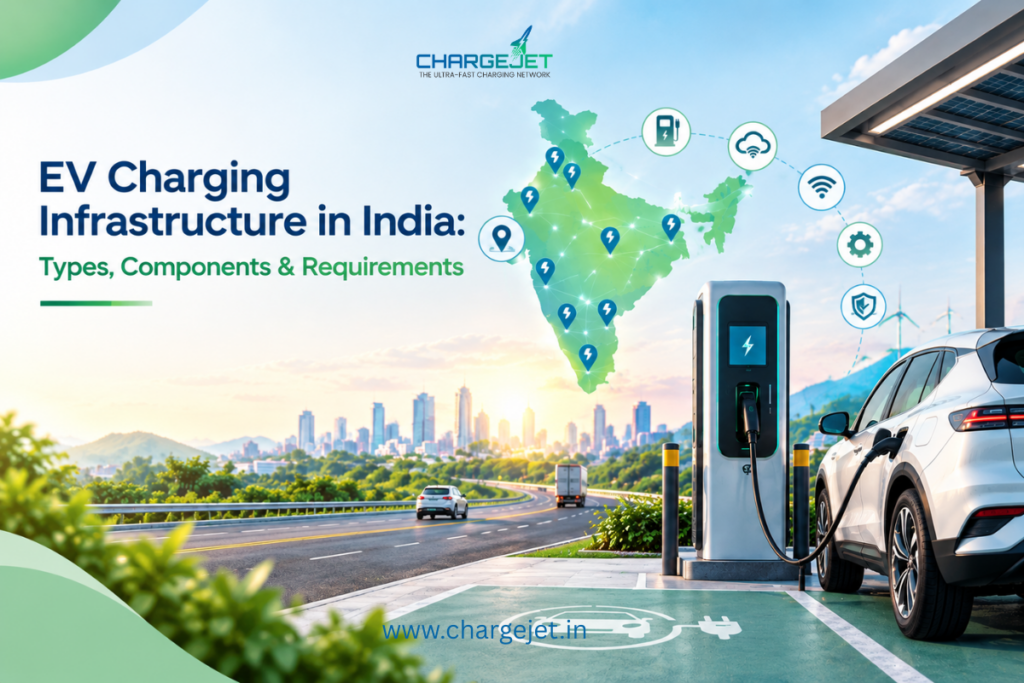
India’s transition towards electric mobility is creating a growing need for reliable, accessible and scalable EV charging infrastructure.
As more electric cars, commercial vehicles, fleets and other EVs enter the market, charging infrastructure needs to expand beyond individual chargers. A practical charging ecosystem requires the right combination of chargers, electrical systems, connectivity, software, locations and operational support.
This is where EV charging infrastructure in India becomes an important part of the electric mobility ecosystem.
But what exactly does EV charging infrastructure include? What types of infrastructure are available? What components are required to build an EV charging station? And what should businesses consider before setting one up?
Let’s understand the complete picture.
What Is EV Charging Infrastructure?
EV charging infrastructure refers to the complete physical and digital system required to charge electric vehicles safely and efficiently.
An EV charger is one part of this infrastructure. The overall system can include:
- AC and DC EV chargers
- Electrical connections and distribution systems
- Power management equipment
- Cables and connectors
- Charging management software
- Communication and network connectivity
- Payment and authentication systems
- Monitoring and remote diagnostics
- Civil and site infrastructure
- Safety and protection systems
- Ongoing maintenance and operational support
In simple terms, the charger delivers power to the vehicle, while the broader EV charging infrastructure makes it possible for that charger to operate reliably as part of a charging location or connected charging network.
This distinction becomes particularly important for businesses planning multiple chargers, highway charging stations, charging hubs or commercial EV charging facilities.
Why Is EV Charging Infrastructure Important in India?
The growth of electric vehicles depends on more than vehicle availability.
Drivers also need convenient places to recharge their vehicles during daily travel, long-distance journeys and commercial operations.
A strong EV charging infrastructure in India can support:
Everyday EV Charging
Charging infrastructure can be deployed at homes, workplaces, residential communities and commercial properties where vehicles remain parked for longer periods.
Long-Distance Travel
Highway charging stations can provide faster charging options for EV drivers travelling between cities.
Commercial and Fleet Operations
Businesses operating electric fleets need charging infrastructure that can support predictable vehicle utilisation and operational schedules.
Hospitality and Destination Charging
Hotels, resorts, restaurants and other destinations can integrate EV charging into their customer experience.
High-Demand Charging Locations
Charging hubs can combine multiple chargers to serve locations where charging demand is expected to be higher.
The result is an EV ecosystem where charging becomes available across different stages of an EV journey.
Types of EV Charging Infrastructure
There is no single charging infrastructure model that works for every location.
The right solution depends on factors such as vehicle type, charging requirement, parking duration, power availability, traffic, location and expected demand.
1. AC EV Charging Infrastructure
AC charging infrastructure supplies alternating current to the vehicle.
The vehicle’s onboard charger converts the AC electricity into the form required by the battery.
AC charging is commonly suitable for locations where vehicles remain parked for relatively longer periods.
Examples include:
- Homes
- Offices
- Hotels
- Resorts
- Residential properties
- Commercial buildings
- Long-duration parking facilities
AC charging can therefore be an effective option when charging speed does not need to be extremely high.
2. DC Fast Charging Infrastructure
DC charging infrastructure is designed for faster charging applications.
Instead of relying primarily on the vehicle’s onboard AC charger for conversion, DC charging equipment supplies direct current to the vehicle’s battery system.
This makes DC fast charging particularly relevant for:
- Highways
- Long-distance travel
- Commercial fleets
- High-traffic locations
- Charging hubs
- High-demand EV charging stations
The actual charging speed depends on the charger’s capacity, the vehicle’s charging capability, battery conditions and other technical factors.
3. Highway EV Charging Infrastructure
Highway charging requires careful planning because drivers typically want to recharge and continue their journey efficiently.
A highway EV charging station may require:
- High-power DC chargers
- Suitable electrical capacity
- Multiple charging bays
- Easy highway accessibility
- Parking and vehicle movement planning
- Clear signage
- Reliable network connectivity
- Payment facilities
- Monitoring and operational support
Location selection is particularly important because the usefulness of a highway charging station depends heavily on accessibility and expected EV traffic.
4. Destination EV Charging Infrastructure
Destination charging allows EV users to charge while they are already visiting a particular location.
Hotels, resorts, restaurants, shopping centres and commercial properties can use destination charging to provide an additional facility for EV users.
For example, a hotel guest may connect their vehicle while checking in or staying overnight.
This model connects EV charging solutions with existing customer journeys rather than treating charging as a separate destination.
5. EV Charging Hubs
An EV charging hub is designed to accommodate multiple chargers and support higher charging demand.
A charging hub may include several AC or DC chargers, depending on the location and intended use.
Charging hubs can be considered for:
- High-traffic areas
- Highway locations
- Fleet operations
- Commercial zones
- Large parking facilities
- Strategic EV corridors
A hub can also provide a foundation for future expansion as EV adoption and charging demand increase.
Key Components of EV Charging Infrastructure
Building a functional charging station requires more than selecting an EV charger.
Several components work together to create a reliable charging environment.
EV Chargers
The charger is the most visible part of the infrastructure.
Depending on the application, a project may use AC chargers, DC fast chargers or a combination of different charger capacities.
The charger selection should consider:
- Vehicle compatibility
- Expected charging demand
- Required charging speed
- Available power
- Site type
- Future expansion
Electrical Infrastructure
The charging equipment needs an appropriate electrical supply.
Depending on the project, electrical infrastructure may include:
- Power distribution systems
- Electrical panels
- Cabling
- Protection equipment
- Switchgear
- Metering
- Earthing systems
- Transformers or other site-specific equipment
The required configuration depends on the charging capacity and the site’s existing electrical infrastructure.
Power Management
When multiple chargers operate simultaneously, managing available power becomes increasingly important.
Power management systems can help distribute available electrical capacity according to operational requirements.
This becomes especially relevant for EV charging hubs and high-power charging locations.
Communication and Connectivity
Connected charging infrastructure needs communication systems that allow chargers to exchange information with network platforms.
Connectivity can support:
- Charger status
- Session information
- Remote monitoring
- Fault notifications
- Usage data
- Operational management
Without reliable connectivity, managing a distributed charging network can become more difficult.
Charging Management Software
Modern EV charging solutions often include software platforms that help operators manage their charging infrastructure.
Depending on the system, software can provide information about:
- Charger availability
- Charging sessions
- Energy usage
- User activity
- Station performance
- Revenue and payments
- Faults and alerts
For businesses operating multiple charging stations, centralised management can provide better visibility across locations.
Payment and Authentication Systems
A commercial charging station needs a convenient way for users to start and pay for charging sessions.
Depending on the network, users may be able to authenticate and pay through:
- Mobile applications
- Digital payment systems
- QR-based systems
- RFID
- Other connected payment methods
The objective is to make the charging process simple while giving operators visibility into transactions and usage.
Site and Civil Infrastructure
The physical location also needs to be prepared for EV charging.
This can include:
- Parking and charging bays
- Civil work
- Signage
- Lighting
- Canopies where required
- Safety barriers
- Vehicle movement areas
- User access areas
The exact requirements vary depending on the site and charging model.
EV Charging Infrastructure Requirements in India
Understanding EV charging infrastructure requirements is essential before starting a charging project.
A typical assessment should consider several areas.
1. Location
Location is one of the most important factors.
A good charging location should be accessible to the intended users and have sufficient demand potential.
For highway projects, factors such as road accessibility, traffic movement and travel patterns become particularly important.
For hotels and commercial properties, customer usage and parking duration may be more relevant.
2. Power Availability
The available electrical power determines how much charging capacity can realistically be installed.
A site intended for multiple high-power DC chargers may require significantly more electrical capacity than a location designed for a few AC chargers.
Power availability should therefore be assessed before finalising the charging configuration.
3. Charger Selection
The right charger depends on:
- Vehicle types
- Expected users
- Required charging speed
- Parking duration
- Location
- Power availability
- Future demand
Installing a charger simply because it has a higher power rating does not necessarily make it the right choice for every location.
4. Number of Chargers
A charging station can have one charger or multiple chargers.
The number depends on expected demand, available space, electrical capacity and business objectives.
A location with high EV traffic may require multiple charging points to reduce waiting times and support more simultaneous charging sessions.
5. Space and Site Layout
The site needs enough space for vehicles to enter, park, charge and exit safely.
For multi-charger stations and charging hubs, traffic movement becomes even more important.
Poor site planning can create congestion even when the charging equipment itself is capable of handling demand.
6. Network Connectivity
For connected EV charging infrastructure, reliable communication is important.
The network should support monitoring, charging-session management and operational visibility.
7. Safety and Protection
Electrical safety is a fundamental part of charging infrastructure.
The project should include suitable protection and safety systems based on the equipment, electrical design and applicable requirements.
8. Operations and Maintenance
Installing charging equipment is only the beginning.
A commercial charging network needs ongoing monitoring, maintenance, troubleshooting and operational support to maintain a consistent user experience.
How Much Does EV Charging Infrastructure Cost?
There is no single fixed cost for EV charging infrastructure.
The investment depends on the charging capacity, number of chargers, site conditions, electrical infrastructure and supporting facilities.
Major cost factors can include:
- EV chargers
- Electrical infrastructure
- Power connection and upgrades
- Civil work
- Cabling and installation
- Software and connectivity
- Site development
- Signage and safety infrastructure
- Operations and maintenance
For example, a small destination charging installation may require a very different investment from a multi-charger highway charging hub.
This is why EV charging projects should be evaluated according to the specific site rather than using one standard installation cost.
How to Plan an EV Charging Infrastructure Project
A structured planning process can reduce technical and operational challenges.
Step 1: Identify the Location
Understand who will use the charging station and why they would stop there.
Step 2: Estimate Charging Demand
Consider current EV traffic, vehicle types, expected usage and future demand.
Step 3: Assess Power Availability
Determine whether the existing electrical infrastructure can support the proposed charging capacity.
Step 4: Select the Charging Configuration
Choose AC, DC or a combination of chargers based on the location and user requirements.
Step 5: Design the Site
Plan charging bays, vehicle movement, electrical equipment, safety systems and supporting facilities.
Step 6: Integrate Network Technology
Connect chargers with the required software, monitoring, payment and communication systems.
Step 7: Plan Operations
Define how the station will be monitored, maintained and supported after installation.
Step 8: Plan for Future Expansion
Consider how the location can accommodate additional chargers if charging demand increases.
This approach helps create an EV charging solution that is designed around the actual requirements of the site.
ChargeJet: Building Scalable EV Charging Infrastructure in India
Building India’s charging ecosystem requires infrastructure that can adapt to different locations, charging requirements and levels of demand.
ChargeJet Energy Private Limited is an EV infrastructure company focused on developing scalable and ultra-fast EV charging solutions for India’s growing electric mobility ecosystem.
Our solutions are designed for different charging environments, including:
En-Route Charging Stations
High-power charging infrastructure designed for highway and long-distance EV travel.
Staycation Chargers
Charging solutions for hotels, resorts and destination locations where EV users can charge while they stay or spend time at the property.
Charging Lounges
A more complete charging environment designed around high-speed charging and the overall user experience.
Charging Hubs
Multi-charger charging infrastructure designed for locations with higher EV charging demand.
ChargeJet’s individual AC chargers are available in 22 kW and 44 kW, while individual DC chargers range from 40 kW to 360 kW.
Multiple chargers can be installed at a single charging station based on site requirements, available electrical power and expected charging demand.
The highest-capacity station currently built by ChargeJet is a 600 kW station configured with two chargers: 360 kW and 240 kW.
This approach allows charging infrastructure to be planned around the location rather than using the same configuration for every project.
For businesses, property owners and partners exploring EV charging infrastructure in India, the right solution depends on several factors, including location, power availability, expected EV traffic, vehicle types, charging requirements and the intended business model.
With a focus on ultra-fast EV charging, scalable infrastructure and connected charging solutions, ChargeJet is working towards building an EV charging network designed for India’s evolving electric mobility needs.
The Future of EV Charging Infrastructure in India
India’s EV charging ecosystem is moving towards a more connected, scalable and location-specific model.
Future charging infrastructure will not simply be about installing more EV chargers. It will involve understanding where charging is required, how quickly vehicles need to charge, how much power a location can support and how the entire network can be managed efficiently.
Highway charging can support long-distance travel.
Destination charging can bring EV charging to hotels and commercial properties.
Charging hubs can support higher demand.
Ultra-fast charging can help reduce charging time where high-power infrastructure and compatible vehicles are available.
Connected software can bring greater visibility to operators and users.
Together, these elements form the foundation of a modern EV charging infrastructure in India.
Frequently Asked Questions About EV Charging Infrastructure
What is EV charging infrastructure?
EV charging infrastructure is the complete physical and digital system required to charge electric vehicles. It can include EV chargers, electrical systems, power management, connectivity, software, payment systems, safety equipment and operational support.
What is EV charging infrastructure in India?
EV charging infrastructure in India includes charging stations and supporting systems deployed across highways, cities, commercial properties, workplaces, hotels, resorts, charging hubs and other locations to support electric vehicles.
What are the main types of EV charging infrastructure?
The main types include AC charging infrastructure, DC fast charging infrastructure, highway charging, destination charging and multi-charger EV charging hubs.
What are the requirements for EV charging infrastructure?
Key requirements can include a suitable location, adequate electrical power, appropriate chargers, site space, electrical and safety systems, connectivity, software, payment systems and ongoing operational support.
What is the difference between an EV charger and EV charging infrastructure?
An EV charger is the equipment that supplies electricity to an electric vehicle. EV charging infrastructure includes the charger plus the electrical, digital, physical and operational systems required to operate the charging facility.
What is an EV charging solution?
An EV charging solution is a charging setup designed around a specific use case or location. It can include hardware, electrical infrastructure, software, connectivity, installation and operational support.
Can EV charging infrastructure include multiple chargers?
Yes. A charging station can be configured with multiple chargers based on available space, electrical capacity, expected demand and the intended use of the location.
What type of EV charging infrastructure is suitable for highways?
Highway locations often require high-power DC charging infrastructure because drivers generally need faster charging during long-distance journeys. The final configuration depends on location, power availability, expected demand and vehicle compatibility.
Is EV charging infrastructure a business opportunity?
EV charging infrastructure can support different business models, including highway charging, destination charging, hospitality charging, fleet charging, charging hubs and partnership-based models. The commercial viability depends on factors such as location, utilisation, investment and operating costs.
How do I choose an EV charging infrastructure company?
Businesses should evaluate factors such as charging technology, infrastructure capabilities, charger options, network management, installation support, scalability, maintenance and experience with the intended charging environment.
Conclusion
EV charging infrastructure in India is becoming a critical part of the country’s electric mobility ecosystem.
A successful charging project requires much more than an EV charger. It needs the right combination of electrical infrastructure, charging technology, power management, connectivity, software, site planning, safety systems and operational support.
The best charging infrastructure is not necessarily the one with the highest charging capacity. It is the infrastructure designed around the location, vehicle requirements, available power, expected demand and long-term business objectives.
As India’s EV market continues to develop, scalable EV charging solutions will play an increasingly important role in making electric mobility more accessible across highways, cities, destinations and commercial locations.
ChargeJet is building towards this future with scalable ultra-fast EV charging infrastructure and network solutions designed for India’s evolving charging requirements.
Explore ChargeJet’s EV charging solutions to plan infrastructure for your highway, destination, business or high-demand charging location.