
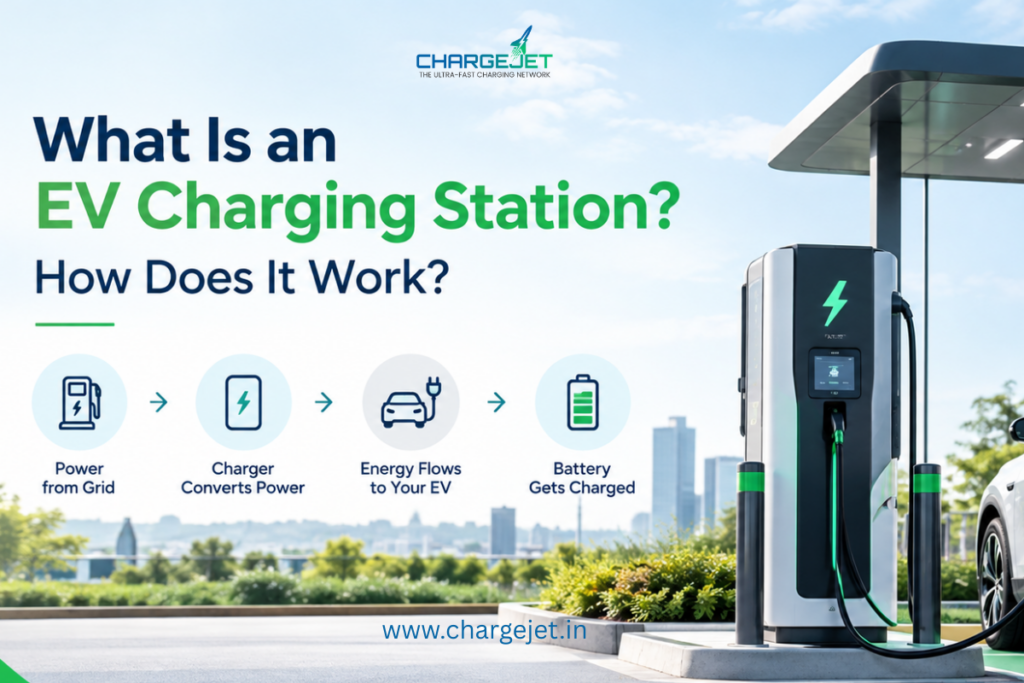
What Is an EV Charging Station? How Does It Work?
Imagine stopping on a highway with your electric car when the battery is running low. Instead of looking for a petrol pump, you pull into an EV charging station, connect your vehicle to a compatible charger, start the charging session through an app or payment system, and continue your journey once enough energy has been added to the battery.
That entire experience is made possible by an EV charging station near you.
An EV charging station is not simply a plug that supplies electricity. It is a combination of EV chargers, electrical infrastructure, safety equipment, communication systems, software and site facilities that work together to safely deliver electricity to an electric vehicle.
As electric mobility expands across India, these stations are becoming an important part of the country’s transportation infrastructure, from city parking areas and offices to hotels, commercial properties and highways.
What Is an EV Charging Station?
An EV charging station is a dedicated location where electric vehicles can connect to an electrical power source and recharge their batteries.
The simplest way to understand it is to compare it with a conventional fuel station:
| Traditional Fuel Station | EV Charging Station |
| Supplies petrol or diesel | Supplies electrical energy |
| Fuel is stored in tanks | Electricity comes through an electrical supply |
| Fuel is transferred through a nozzle | Electricity is transferred through a charging connector |
| Refuelling generally takes minutes | Charging time depends on the charger and vehicle |
| Fuel pump controls fuel delivery | Charger manages the charging process |
However, an EV charging station involves considerably more than the charger itself.
A public charging location may have multiple chargers, dedicated parking bays, electrical distribution equipment, power protection systems, networking equipment, payment systems and software that allows operators to monitor the station remotely.
This is why the terms EV charger and EV charging station should not always be treated as exactly the same thing.
EV Charger vs EV Charging Station
An EV charger is the equipment that delivers electrical energy to the vehicle.
An EV charging station is the complete charging location, which can include one or several chargers along with the electrical, digital and physical infrastructure needed to operate them.
In simple terms:
The charger is the equipment. The charging station is the complete setup around that equipment.
How Does an EV Charging Station Work?
Although charging an EV can feel as simple as plugging in a cable, several systems work together behind the scenes.
Let’s break this process down.
1. Electricity Reaches the Charging Station
The process begins with an electrical power supply.
Depending on the size of the charging facility, the site may require different levels of electrical infrastructure. A small destination charger and a high-demand highway charging hub can have very different power requirements.
Electrical distribution equipment, protection systems and metering help ensure that electricity reaches the charging equipment safely and in a controlled manner.
2. The Charger Prepares the Power
The charging system then manages how electricity is delivered to the vehicle.
This is where the difference between AC charging and DC charging becomes important.
With AC charging, alternating current is supplied to the vehicle and the vehicle’s onboard charger converts it into the DC electricity required by the battery.
With DC fast charging, the conversion is handled by the charging equipment itself, allowing compatible vehicles to receive DC power more directly.
This is one of the reasons DC charging can support much faster charging than many conventional AC systems.
3. The Vehicle and Charger Communicate
Charging is not simply a matter of sending electricity through a cable.
The vehicle and charging equipment communicate with each other to determine how the charging session should operate.
The vehicle’s battery management system monitors conditions such as battery state and temperature and controls how much power the battery can accept.
This is why plugging a vehicle into a very high-powered charger does not necessarily mean the vehicle will continuously charge at that charger’s maximum output.
4. The Charging Session Begins
At a public charging station, the user may interact with the charging network through an app, QR code, RFID system, payment interface or another supported method.
Once the session is authorised, the charger begins supplying power.
Behind the scenes, the charging network can record information such as:
- Charging session duration
- Energy delivered
- Charger status
- Payment information
- Station availability
- Fault or maintenance alerts
This connected infrastructure is what transforms a basic charger into part of a modern EV charging network.
AC vs DC Charging: Why Does It Matter?
One of the first things businesses and EV owners encounter when exploring charging infrastructure is the difference between AC and DC charging.
The key difference is where the conversion from AC electricity to DC electricity takes place.
AC Charging
AC charging supplies alternating current to the vehicle.
The vehicle’s onboard charger converts that electricity into the DC power required by the battery.
This approach is commonly suitable for locations where vehicles remain parked for longer periods, such as:
- Homes
- Offices
- Hotels
- Residential buildings
- Destination locations
DC Fast Charging
With DC fast charging, the charging equipment performs the power conversion externally and delivers DC power to the vehicle.
Because the conversion does not rely primarily on the vehicle’s onboard AC charger, compatible EVs can generally accept significantly higher charging power.
This makes DC fast charging particularly relevant for:
- Highways
- Public charging networks
- Fleet operations
- Charging hubs
- High-traffic commercial locations
The important point
Charging speed depends on more than the charger’s power rating.
The vehicle’s battery capacity, charging capability, battery temperature, state of charge and charging curve all influence the actual charging experience.
What Happens Inside an EV During Charging?
This is where EV charging becomes more interesting. When you connect an EV to a charging station, the battery does not simply receive electricity at a constant rate from the beginning to the end of the charging session. Instead, the vehicle continuously monitors and manages the charging process to deliver the appropriate amount of power at each stage.
One of the most important components involved in this process is the Battery Management System (BMS). The BMS acts as the control system for the EV battery, monitoring parameters such as voltage, current, temperature, state of charge (SoC), and the condition of individual battery cells. It uses this information to determine how much charging power the battery can safely accept at a given moment.
As the battery becomes more charged, the BMS continuously evaluates battery temperature, voltage, cell conditions, and state of charge. When the battery approaches a higher state of charge, the system may gradually reduce the amount of power being delivered. This reduction helps manage battery stress and temperature while maintaining safe operating conditions.
The BMS also helps protect individual battery cells. Since an EV battery consists of many interconnected cells, maintaining an appropriate voltage and temperature across the battery pack is essential. The BMS monitors these cells and can take corrective action when it detects conditions outside the permitted operating range.
In simple terms, EV charging is a coordinated process between the charging station, vehicle, battery, BMS, and thermal management system. The charger provides the available power, while the vehicle and BMS determine how much power the battery can safely accept. This intelligent control helps balance charging speed, battery protection, thermal management, efficiency, and long-term battery performance.
What Makes Up EV Charging Infrastructure?
When people talk about installing an EV charging station, they often focus on the charger.
But the charger has only one component.
A complete EV charging infrastructure project may include:
- Charging Equipment
The actual AC or DC charging hardware that delivers energy to the vehicle.
- Electrical Infrastructure
Power distribution, transformers where required, protection equipment, cabling and other electrical components.
- Charging Connectors
The physical connection between the charging equipment and the vehicle.
- Communication & Networking
Systems that allow the charger to communicate with vehicles and central charging-management platforms.
- Software
Digital platforms can monitor station status, manage charging sessions, process payments and provide operational data.
- Safety Systems
Protection equipment and appropriate electrical design help support safe operation.
- Site Infrastructure
Depending on the location, this can include parking bays, foundations, lighting, signage, access arrangements and other facilities.
This is why setting up an EV charging station is an infrastructure project, not simply a hardware installation.
How Long Does EV Charging Take?
There is no universal answer to the question, “How long does it take to charge an EV?”
Two EVs connected to the same charger may not charge at exactly the same speed.
The charging time can depend on:
- Battery capacity
- Current battery percentage
- Maximum charging capability of the vehicle
- Charger power
- Battery temperature
- Charging curve
- Electrical conditions
- Vehicle and charger compatibility
A simple example
Consider two vehicles connected to the same DC fast charger.
Vehicle A may be capable of accepting a higher charging rate, while Vehicle B may have a lower maximum charging capability.
Even though both vehicles are connected to the same charger, their charging speeds can be different.
This is why charger power should always be considered alongside vehicle capability.
Where Are EV Charging Stations Used in India?
EV charging infrastructure is not limited to one type of location.
Different locations serve different charging needs.
- Homes
For overnight or routine charging when the vehicle remains parked for several hours.
- Offices
Employees can charge while their vehicles are parked during working hours.
- Hotels & Resorts
Charging can become an additional facility for guests travelling with EVs.
- Commercial Properties
Shopping centres, restaurants and other destinations can offer charging while customers are already using the property.
- Highways
Highway charging stations help EV users recharge during longer journeys.
- Fleet Locations
Fleet operators can use dedicated charging infrastructure around vehicle operating schedules.
- Charging Hubs & Lounges
High-demand locations can combine multiple chargers with additional facilities to create a dedicated charging destination.
Why Is EV Charging Infrastructure Important for India?
India’s transition towards electric mobility depends on more than the number of EVs on the road.
Drivers also need confidence that they can find, access and use charging infrastructure when required.
For a person driving an EV within a city, convenient destination or workplace charging may be sufficient.
For someone travelling between cities, the requirements are different.
They need strategically located charging stations along their route, suitable charging speeds, reliable equipment and easy access to charging information.
This creates different opportunities for:
- Highway charging networks
- Commercial charging locations
- Fleet charging
- Hospitality charging
- Charging hubs
- Destination charging
A strong EV charging network therefore supports both everyday mobility and longer-distance electric travel.
What Does It Cost to Set Up an EV Charging Station in India?
There is no single price for setting up an EV charging station.
The investment can vary significantly depending on the type and scale of the project.
For example, the requirements for a single destination charger can be very different from those for a multi-charger highway charging hub.
Factors can include:
- Charger type
- Charging power
- Number of chargers
- Electrical connection
- Transformer requirements
- Civil work
- Installation
- Land or parking arrangements
- Software and networking
- Safety equipment
- Maintenance
- Location
Therefore, businesses should evaluate the complete project cost and operational requirements, rather than comparing charger prices alone.
What Do You Need to Start an EV Charging Station?
A successful charging station starts with the right site and infrastructure planning.
The process may involve:
1. Select the location
Evaluate accessibility, traffic, EV demand, parking and surrounding facilities.
2. Assess electrical capacity
Understand the available power supply and the infrastructure required for the proposed chargers.
3. Select suitable chargers
Choose AC, DC fast or higher-power charging based on the expected users and site requirements.
4. Plan the infrastructure
Design electrical systems, charging bays, safety equipment, connectivity and other site requirements.
5. Install and commission
Complete the physical installation, testing and commissioning of the charging equipment.
6. Connect the station to a charging network
Network connectivity can enable monitoring, payments, station status and operational management.
7. Operate and maintain
Regular monitoring and maintenance help keep chargers available and reliable.
How to Choose the Right EV Charging Station?
The “right” charging station depends on who will use it and how the location will operate.
Before selecting equipment, consider:
Who will use the charger?
Private EV owners, hotel guests, highway travellers and commercial fleets have different requirements.
How long will vehicles typically stay?
Long parking periods may support AC charging, while short stops may require faster DC charging.
What power is available?
The site’s electrical infrastructure must support the intended charging capacity.
What is the expected demand?
A location expecting high vehicle traffic may require multiple charging points.
Is the location future-ready?
The infrastructure should be considered with potential future EV demand in mind.
Common Mistakes When Setting Up EV Charging Infrastructure
Focusing only on charger price
The charger is only one part of the overall project.
Selecting maximum power without checking vehicle demand
Higher power is not automatically better if the target vehicles cannot use it.
Ignoring the location
A good charger in a difficult-to-access location may not deliver the expected utilisation.
Underestimating electrical requirements
Charging infrastructure needs appropriate electrical planning.
Forgetting the user experience
Easy access, clear information, simple payment and reliable station availability all contribute to a better charging experience.
How ChargeJet Is Building EV Charging Infrastructure in India
Building a reliable EV charging network in India requires more than installing individual chargers. It requires the right combination of EV charging infrastructure, high-power charging technology, strategic locations, network management and ongoing operational support.
ChargeJet Energy Private Limited is an ultra-fast EV charging network company in India, delivering scalable EV charging solutions for highways, businesses, destinations and high-demand locations. Our charging infrastructure is designed to support the growing demand for fast and ultra-fast EV charging across India’s evolving electric mobility ecosystem.
ChargeJet’s charging solutions range from 22 kW to 360 kW per individual charger, while multiple chargers can be deployed at a single charging station based on site capacity, power availability and charging demand.
ChargeJet EV Charging Solutions
Our solutions are designed for different charging use cases:
- En-Route Charging Stations – High-power highway EV charging stations designed for long-distance and intercity travel.
- Staycation Chargers – EV charging solutions for hotels, resorts and destinations, allowing guests to charge while they stay.
- Charging Lounges – A more complete EV charging experience combining high-speed charging with a comfortable destination environment.
- Charging Hubs – Scalable EV charging infrastructure with multiple chargers for locations with higher charging demand.
The right EV charging station depends on several factors, including location, available electrical power, expected EV traffic, vehicle types, charging requirements and the intended business model.
For businesses and property owners, ChargeJet can help develop a charging infrastructure model aligned with the specific requirements of the site. From individual EV chargers to multi-charger EV charging hubs, the infrastructure can be planned to support both current requirements and future charging demand.
With a focus on ultra-fast EV charging, scalable infrastructure and network-led charging solutions, ChargeJet is building charging infrastructure designed for India’s next phase of electric mobility.
Explore ChargeJet’s EV charging solutions and discover how you can build or expand an EV charging station for your location.
What is an EV charging station?
An EV charging station is a location equipped with charging equipment and supporting infrastructure that allows electric vehicles to recharge their batteries.
How does an EV charging station work?
Electricity reaches the charging infrastructure, the charger manages the power transfer, and a compatible connector delivers electricity to the EV. The vehicle’s battery management system controls how much power the battery accepts.
What is EV charging infrastructure?
EV charging infrastructure includes chargers, electrical systems, connectors, safety equipment, software, networking, payment systems and physical site facilities required to operate charging services.
How long does it take to charge an EV?
Charging time depends on the vehicle, battery capacity, charger power, battery state of charge, temperature and charging curve.
Does a 60 kW charger always charge an EV at 60 kW?
No. The vehicle must be capable of accepting that charging power, and actual charging speed can change during the session.
How much does an EV charging station cost in India?
Cost varies based on charger type, power capacity, number of chargers, electrical infrastructure, installation, location, civil work and operational requirements.
Can businesses install EV charging stations?
Yes. Businesses can explore EV charging installations for offices, hotels, commercial properties, fleets, highways and other suitable locations.
What is a highway EV charging station?
A highway EV charging station is a charging facility positioned along or near major travel routes to support EV drivers during intercity or long-distance journeys.
What is a charging hub?
An EV charging hub is a location designed to accommodate multiple charging points or chargers, often supporting higher charging demand than a single charging location.
Can one charging station support different EVs?
It can support different EVs when the available chargers and connectors are compatible with those vehicles.